When Core Became King (Part 3)

By Dr. Lisa Hill
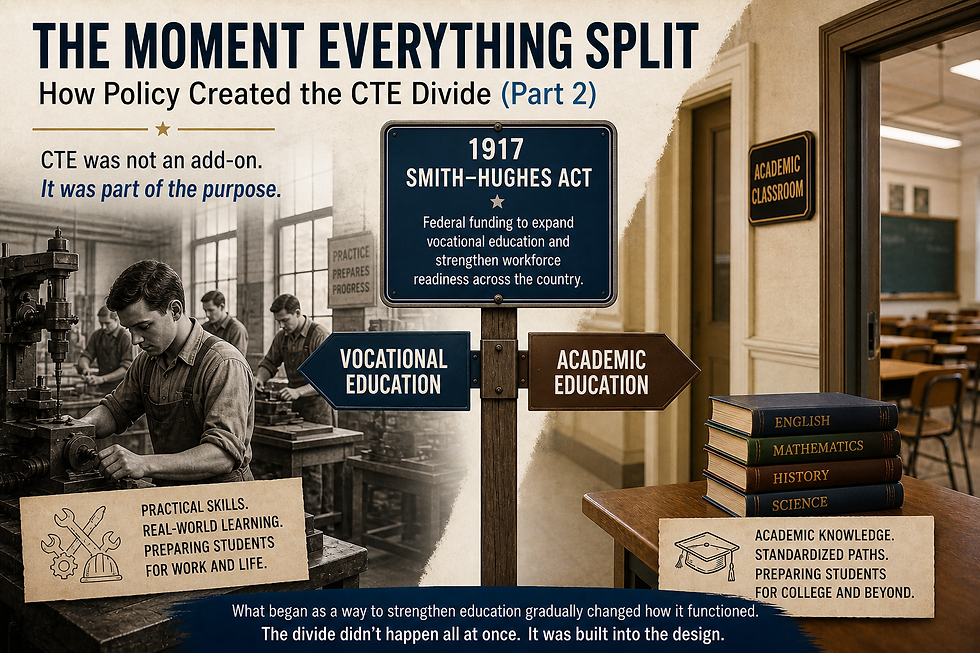
In Part 2, we looked at how policies like the Smith–Hughes Act gradually separated vocational education programs from the academic core within American public schools.
What started as a structural shift in funding and oversight slowly changed something much larger:
How schools defined success.
As public education grew throughout the mid-1900s, schools were expected to serve more students while preparing young people for an increasingly competitive economy. To manage that growth, school became more structured.
Schedules became tighter.
Seat-time requirements became fixed.
Academic tracks became more defined.
Testing and accountability systems expanded.
These structures created a more standardized approach to schooling across the country. But they also reinforced a new reality: Core academic subjects increasingly became the center of how schools measured success.
Then Sputnik changed the national conversation.
When the Soviet Union launched Sputnik in 1957, it did more than shock the United States.
It changed how the country viewed its schools.
Suddenly, public education became tied to mathematics, science, technological advancement, and the nation’s ability to compete on a global stage.
Academic rigor became a national priority. And over time, the belief that stronger core academics would solve larger societal concerns became deeply embedded within public education.
And the shift didn’t stop there.
By the time A Nation at Risk was released in 1983, academic performance had become closely connected to the nation’s economic future. Schools responded by increasing core graduation requirements, expanding standardized testing, and placing even greater emphasis on measurable academic outcomes.
And over time, schools increasingly centered everything around core academic performance.
Core academics no longer simply existed alongside Career & Technical Education (CTE).
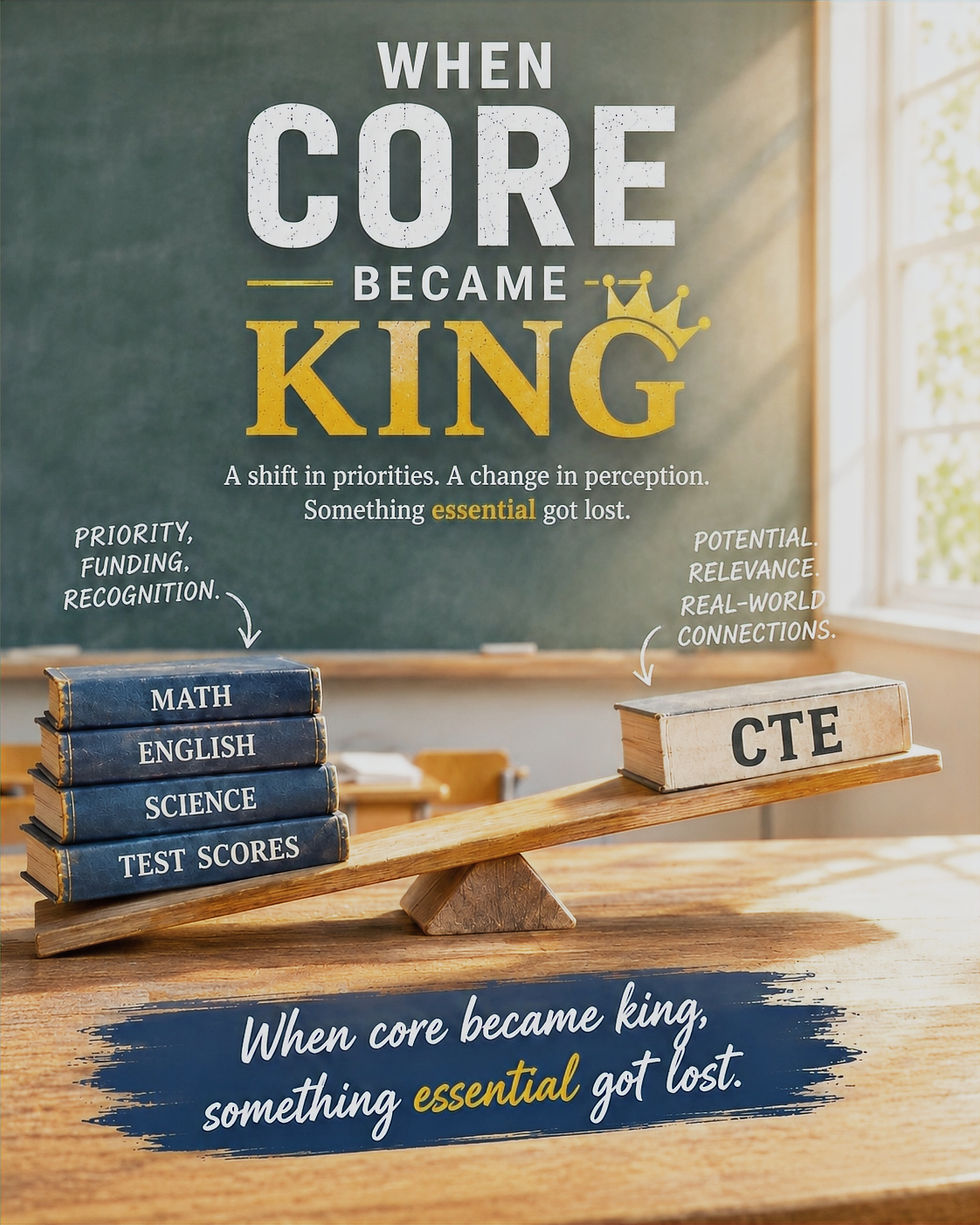
Core became king.
Not because CTE disappeared. And not because CTE lacked importance. But because core performance became the dominant way schools measured readiness, rigor, and achievement.
To be clear, core learning matters. It always has.
Strong literacy, mathematics, science, communication, and analytical skills are essential for students. The problem was never the existence of core academics. The problem was what happened when schools narrowed their definition of readiness to performance in core academic subjects.
Because knowledge without application does not always create direction.
Students could pass classes.
Meet benchmarks.
Earn credits.
And still struggle to see how school prepared them for what came next.
Meanwhile, CTE classrooms continued offering something many students were searching for:
Purpose.
CTE classrooms helped students see the relevance of core learning by connecting it to real industries, real careers, and real-world application.
But as public schools increasingly prioritized tested core performance, Career & Technical Education moved further from the center of how schools defined success.
And over time, that change didn’t just reshape school structures.
It reshaped perception, because when core became king, something essential got lost.
Next: How Career & Technical Education gradually became viewed as a pathway for “certain students”—and why that perception still impacts schools today.
CTE by Design is part of the ForwardED Network, a collective of educators supporting educators. Dr. Lisa Hill is founder of CTE by Design, co-founder of the network, and creator and host of Vice Principal UnOfficed, a comedy podcast sharing funny, true stories about schools.
Explore CTE by Design. Connect with ForwardED Network or listen to Vice Principal UnOfficed on your favorite podcast platform.
This article is also published through ForwardED Network. View article ratings and additional insights there.