
The Moment Everything Split: How Policy Created the CTE Divide (Part 2)

By Dr. Lisa Hill
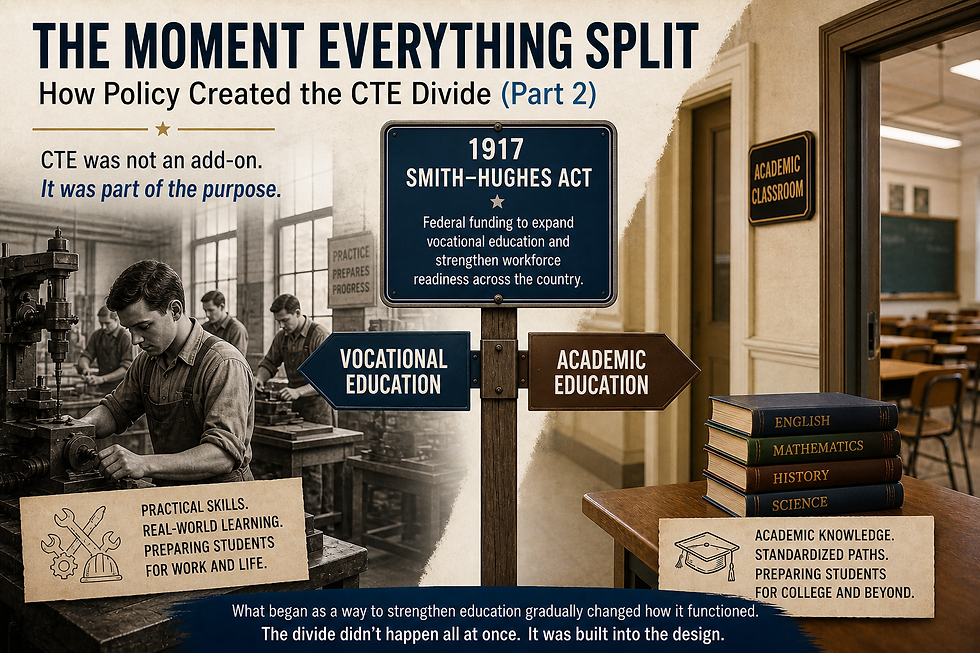
For most people, the divide between core academics and Career & Technical Education (CTE) feels like a natural part of how schools operate.
It’s not.
It was built.
And it didn’t start with a disagreement about what mattered in education. It started with a shared goal.
In the early 1900s, the United States was changing rapidly. Industry was expanding, new technologies were emerging, and the workforce was evolving beyond manual labor into more specialized, technical roles. Schools were not just places of learning, they were expected to prepare students to participate in that changing economy.
At that time, education looked different than it does today.
Academic learning and career preparation were not separate experiences. Students often learned foundational subjects alongside practical skills. Early workforce models, even outside of schools, intentionally blended the two. Apprenticeship systems, for example, combined math, science, and technical skill development in ways that made learning both relevant and immediately applicable.
CTE was not an add-on. It was part of the purpose.
And, what had been happening in practice was about to be formalized in policy.
In 1917, the Smith–Hughes Act was passed to support vocational education and prepare students for the workforce. At the time, the country was evolving rapidly. Industry was expanding, and there was a clear need for schools to help students develop practical, job-ready skills.
The intention was clear:
Prepare students for real work.
Support economic growth.
Create opportunity through education.
And in many ways, it worked.
The Act brought national attention and resources to vocational education. It validated the importance of preparing students for real work and gave schools the ability to expand those opportunities.
But the structure of the law introduced a shift that would shape education for the next century.
Instead of embedding vocational education within a unified system, the Act supported it through separate channels. Funding, oversight, and program development began to operate with more independence from the academic core.
At the time, that separation made sense. Vocational education required specialized resources, different equipment, and connections to industry. Creating distinct structures allowed programs to grow and respond to workforce needs.
But structure does more than support growth. It shapes how systems function over time.
As vocational education and academic education began operating through different channels, they also began evolving in different ways. What started as a practical decision gradually created distance, not because anyone intended to divide learning, but because the system was no longer developing as one.
Even early leaders recognized this possibility. There was concern that separating systems could lead to long-term division.
They were right.
Because once systems operate separately, alignment becomes harder to maintain.
What began as a way to strengthen education gradually changed how it functioned.
Instead of a connected system preparing students through both academic and applied learning, schools began to carry parallel structures, each with its own expectations, measures, and ways of operating.
The divide didn’t happen all at once.
It was built into the design.
And once structure is in place, it quietly shapes everything that follows.
Next: How the divide expanded and shaped how schools operate today.
CTE by Design is part of the ForwardED Network, a collective of educators supporting educators. Dr. Lisa Hill is founder of CTE by Design, co-founder of the network, and creator and host of Vice Principal UnOfficed, a comedy podcast sharing funny, true stories about schools.
Explore CTE by Design. Connect with ForwardED Network or listen to Vice Principal UnOfficed on your favorite podcast platform.
This article is also published through ForwardED Network. View article ratings and additional insights there.
